Manipur: When It Became My Home
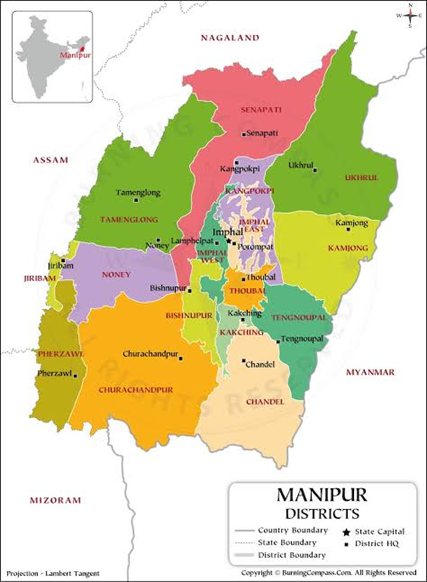
One more resemblance between Maharashtra and Manipur that we witnessed was at Churachandpur School. We visited a school in Churachandpur district of Manipur, approximately 61 km from Imphal. It shares a border with Myanmar. Churachandpur is one of the five districts of Manipur that share a section of the 398 km-long international border with Myanmar. Manipur has a total of 16 districts.
Now, one may ask, "What's so special about this school that we made a special visit to it?" Yes, it is special. It was established by one visionary personality, Pa. Pu. Shri Bhaiyyaji Kane, in 1971.
Just imagine—a person from Konkan travelled all the way to Manipur to establish schools in border areas, keeping in mind the importance of border security and believing that education is the strongest medium to connect people, encourage logical thinking, and help them realise their own potential.
He established the “Purva Seema Vikas Pratishthan Sanstha”, under which three schools were started in Ukhrul, Taminglong, and Churachandpur. Through this initiative, he provided quality education in a region that needed it the most. I could write an entirely different chapter on Purva Seema's work, but I will stick to what I felt during this visit. If you'd like to know more about their work, do let me know in the comments—I would be happy to write a separate piece on it.

There, we met the school coordinator, his daughter, the teachers, and, of course, Dr. Vasudha Pingale, a Maharashtrian from Dombivli who went all the way to Manipur to teach. Her story is incredibly inspiring. I have tried to capture her journey in a separate article.

The children were so happy and full of energy. I could literally feel the abundance of energy all around. Some classes were going on, while outside, children were playing and climbing trees. Inside the classrooms, the children looked at us with great curiosity.
The school is located on a small hilltop, and it was so peaceful—a truly beautiful environment to learn in. It reminded me of Rabindranath Tagore's Shantiniketan.

While interacting with the teachers and children, they shared that special emphasis is given to Science, Mathematics, Hindi, and English. Along with academics, values are taught through games, poems, and songs. Rediscovering their own cultural roots is also a part of their holistic learning.
We were served red tea and sticky rice cooked in a leaf. It was served hot and steamy. It had no added sugar or salt, yet the flavour of the leaf had been absorbed by the rice, giving it a simple and natural taste.
This was a beautiful start to the journey. From the shivir till then, I had been blessed to meet such incredible people doing phenomenal work—without marketing, without expecting recognition or acknowledgement. In the true sense, "Karmanyevadhikaraste Ma Phaleshu Kadachana."
I started to feel a sense of purity and happiness. It is deeply satisfying, though challenging. But believe me, it is contagious. This kind of pure-hearted work is difficult, but it pulls you in, motivates you, and keeps you on this path.
Later, we went to witness the beauty of Loktak Lake, one of Manipur's major tourist attractions. It is often referred to as the world's only floating lake. Floating islands of vegetation thrive there, fishing is a major livelihood, and the unique Sangai deer, Manipur's state animal, can be found in the nearby Keibul Lamjao National Park.

The floating masses of vegetation are called Phumdis. The lake is famous for its lotus. We got to taste the raw seeds of the makhana plant before they are roasted and turned into fox nuts. Lotus silk is also quite well known in the region.
Soaking in the natural beauty, the cool breeze, and the warm sun, we returned home.

The day wasn't over yet. Oja Jadumani Ji, a senior karyakarta, came to visit us at the karyalaya. Meeting him felt strangely familiar, as if I had known him for years. His calm nature and the brilliance (tej) on his face were clearly visible. Oja in Meitei is termed as respected. Then, Shantibala Di hugged me and lovingly told me to call her Nene. In Meitei, Nene means Atya or Bua. Our landlord, Joy Da, also came to visit us. The previous day, Sarita Didi had come to meet us.
All these people, despite their own responsibilities and work, have joined such organisations to serve society. They gave my Aai and Baba the comfort of knowing that I was not alone—that I was among family.
I couldn't process it immediately. Here were people who didn't even know me personally, yet they cared for me like family. They understood what it meant for a girl to come all the way from Maharashtra. They truly understood me.
And there were many more to come—Sujeta di, Priobrar da, Shital di, Yaima di, Sushma di, Siddharth da, Surchandra Da, and many others.
Because of them, it felt like home.
They had become my home.


Comments